


















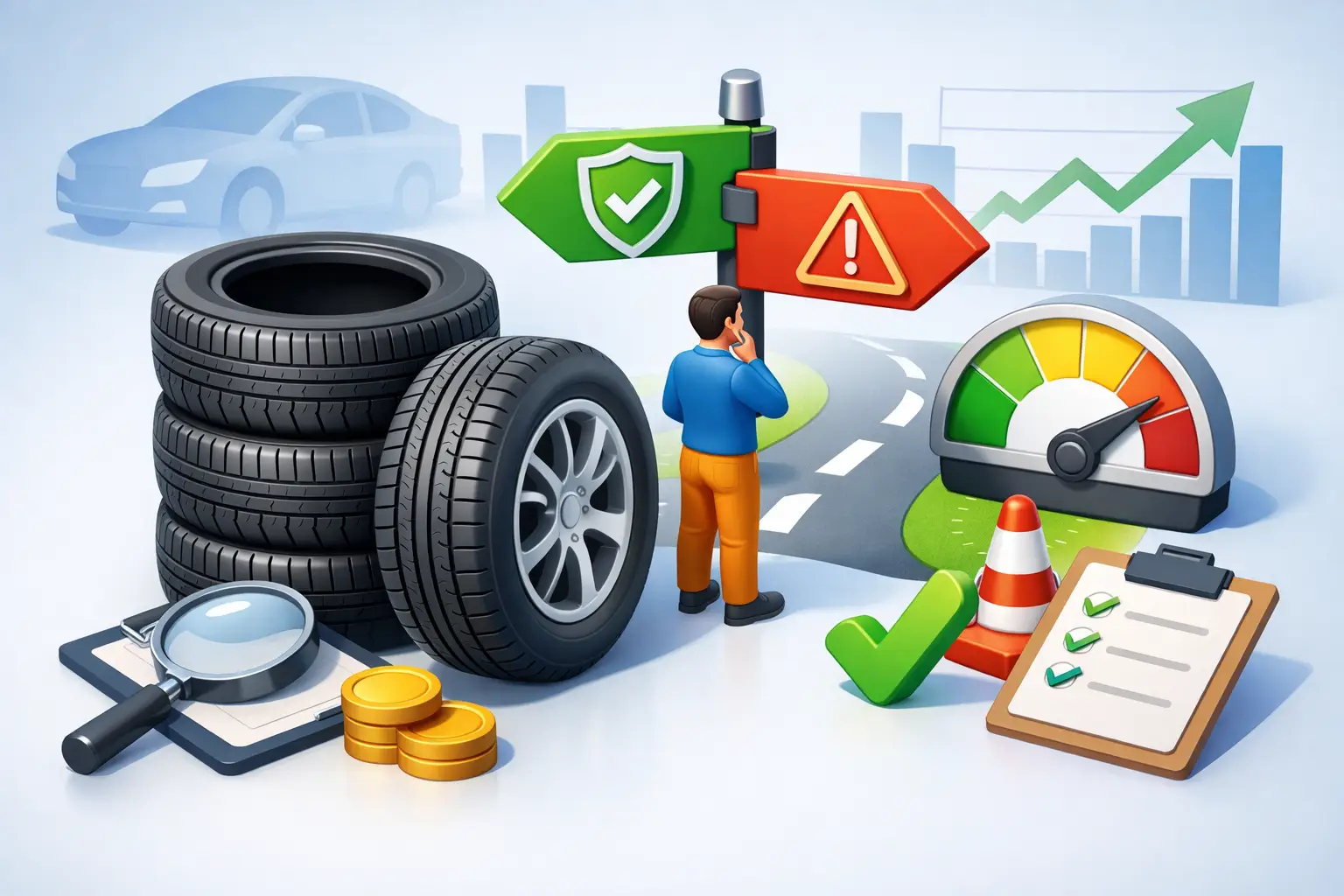
A low price at checkout can feel like a win, but not if the tires are noisy, wear out early, or lose confidence on wet roads. Knowing how to choose budget tyres means looking beyond the advertised price and focusing on the factors that protect your vehicle, passengers, and long-term budget.
Budget tires can be a sensible choice for everyday cars, family SUVs, and vehicles with moderate annual mileage. The key is to buy the right value tire for your actual driving, not simply the cheapest tire available in the correct size.
Start With the Correct Tire Size
Your tire size is not a suggestion. It is the baseline for safe handling, braking, speedometer accuracy, and load support. Check the sidewall of your current tire, the sticker inside the driver’s door, or your owner’s manual before comparing products.
A size such as 225/55R17 tells you the tire width, sidewall profile, construction type, and wheel diameter. You should also check the load index and speed rating that follow the size. A budget tire must meet or exceed the vehicle manufacturer’s minimum specifications. Choosing a cheaper tire with a lower load or speed rating is false economy, especially for SUVs, vehicles carrying family passengers, or cars that regularly travel at highway speeds.
It is sometimes possible to change sizes, but that decision needs professional guidance. A different tire profile may affect ride comfort, fuel use, suspension clearance, and the accuracy of vehicle safety systems. For most drivers, matching the approved size is the safest, simplest choice.
How to Choose Budget Tyres for Your Driving
Not every value tire is designed for the same job. Before comparing prices, think honestly about where and how your vehicle is used. A commuter covering short city trips has different needs from a driver who travels long highway distances, uses rough roads, carries heavy loads, or takes a 4×4 off pavement.
For everyday driving, look for a touring or passenger tire with dependable wet grip, a comfortable ride, and reasonable tread life. If your vehicle spends most of its time in city traffic, low road noise and predictable braking may matter more than a high-speed performance rating you will never use.
SUV and crossover owners should pay particular attention to load capacity and sidewall strength. A lower-priced tire can still be a good fit, but it should be designed for the vehicle’s weight and intended use. If you drive on gravel, uneven roads, or desert terrain, an all-terrain pattern may offer more confidence than a road-focused tire. The trade-off is usually extra noise, firmer ride quality, and potentially higher fuel consumption.
Performance-car drivers should be especially selective. Budget tires may be suitable for relaxed daily driving, but aggressive cornering, repeated hard braking, and high summer temperatures put more demand on compound and construction. If grip and steering response are priorities, a mid-range or premium option may deliver better value over its service life.
Check Safety Ratings Before You Check Out
Price should be one filter, not the only filter. Review the tire’s wet-grip performance, load index, speed rating, and stated warranty where available. Wet traction deserves close attention because a tire that feels acceptable on dry pavement can behave very differently during rain or on slick roads.
Look for a tread pattern with clear channels designed to move water away from the contact patch. Deep circumferential grooves and well-defined sipes can support wet-road control, although tread design alone does not tell the entire story. The rubber compound, casing construction, and overall quality control matter too.
Recognized tire brands in the value category often provide a more dependable balance of safety standards, manufacturing consistency, and warranty support than unknown products with limited technical information. That does not mean every budget tire is poor, or every expensive tire is automatically right for your vehicle. It means you should be able to verify what you are buying.
Avoid products with unclear markings, missing specifications, or claims that sound too good for the price. A genuine tire from a known manufacturer, sold with clear sizing and fitment details, gives you a stronger starting point.
Compare Cost Per Mile, Not Just Cost Per Tire
A cheaper tire that lasts 20,000 miles may cost more over time than a slightly higher-priced tire that lasts 40,000 miles. The same applies when a tire’s poor rolling resistance increases fuel consumption or when uneven wear forces an early replacement.
Compare the purchase price with the expected tread life, warranty coverage, and your annual mileage. If you drive only a few thousand miles each year, paying extra for an ultra-high-mileage tire may not make sense because tires also age. If you cover long distances every week, better tread life and fuel efficiency can quickly justify a higher initial price.
There is also a practical point: replace tires in pairs on the same axle whenever possible. Mixing different tread patterns, wear levels, or grip characteristics across an axle can make braking and handling less predictable. For all-wheel-drive vehicles, follow the manufacturer’s guidance closely, as significant differences in tire circumference can place extra stress on the drivetrain.
Inspect the Tire’s Age and Condition
A tire can be unused and still be old. Rubber changes over time, particularly when stored in heat or direct sunlight. Check the DOT code on the sidewall when available. The final four digits show the week and year of manufacture. For example, 2425 means the tire was made in the 24th week of 2025.
There is no universal single age limit that fits every tire and every climate, but fresher stock is generally preferable. This matters even more in hot conditions, where heat can accelerate rubber aging. Ask about the manufacturing date if it is not clearly stated, and never accept a tire with visible cracking, deformation, sidewall damage, or signs of poor storage.
Buying used tires may seem like the lowest-cost route, but it carries more uncertainty. Hidden repairs, impact damage, internal separation, and uneven wear are difficult to judge from a quick visual inspection. For most motorists, a new budget tire from a trusted retailer is the safer value decision.
Do Not Treat Installation as an Extra
The tire is only part of the purchase. Correct fitment, balancing, valve inspection, and wheel alignment affect how the tire performs from day one. Poor balancing can cause vibration. Incorrect inflation can accelerate shoulder or center wear. Misalignment can destroy a new set of tires far sooner than expected.
Professional installation also gives a technician the chance to spot issues such as bent wheels, worn suspension parts, or irregular wear patterns from the old tires. Those details help prevent the same problem from damaging your replacement set.
After installation, check tire pressures monthly when the tires are cold and rotate them according to your vehicle manufacturer’s recommendation. These small habits protect tread life and help your budget purchase deliver the value you expected.
When Budget Tires Are the Right Choice
Budget tires are often a smart match for drivers who use their vehicles normally, maintain correct pressure, and want dependable replacement tires without paying for specialized performance features. They can work well on a second car, a city commuter, a family vehicle with moderate mileage, or a vehicle being prepared for sale.
They may not be the best choice if you frequently tow heavy loads, drive at sustained high speeds, use demanding off-road terrain, or expect track-level grip. In those cases, the tire is doing more demanding work, and the extra capability of a purpose-built mid-range or premium product can be money well spent.
The best purchase is not the lowest number on a product page. It is the tire that fits your vehicle, matches your roads and driving habits, and arrives with professional fitment support. At GCC Tires, that means choosing with clear specifications, genuine products, and the confidence to drive away knowing your savings did not come at the expense of control.

 Get This Deal