












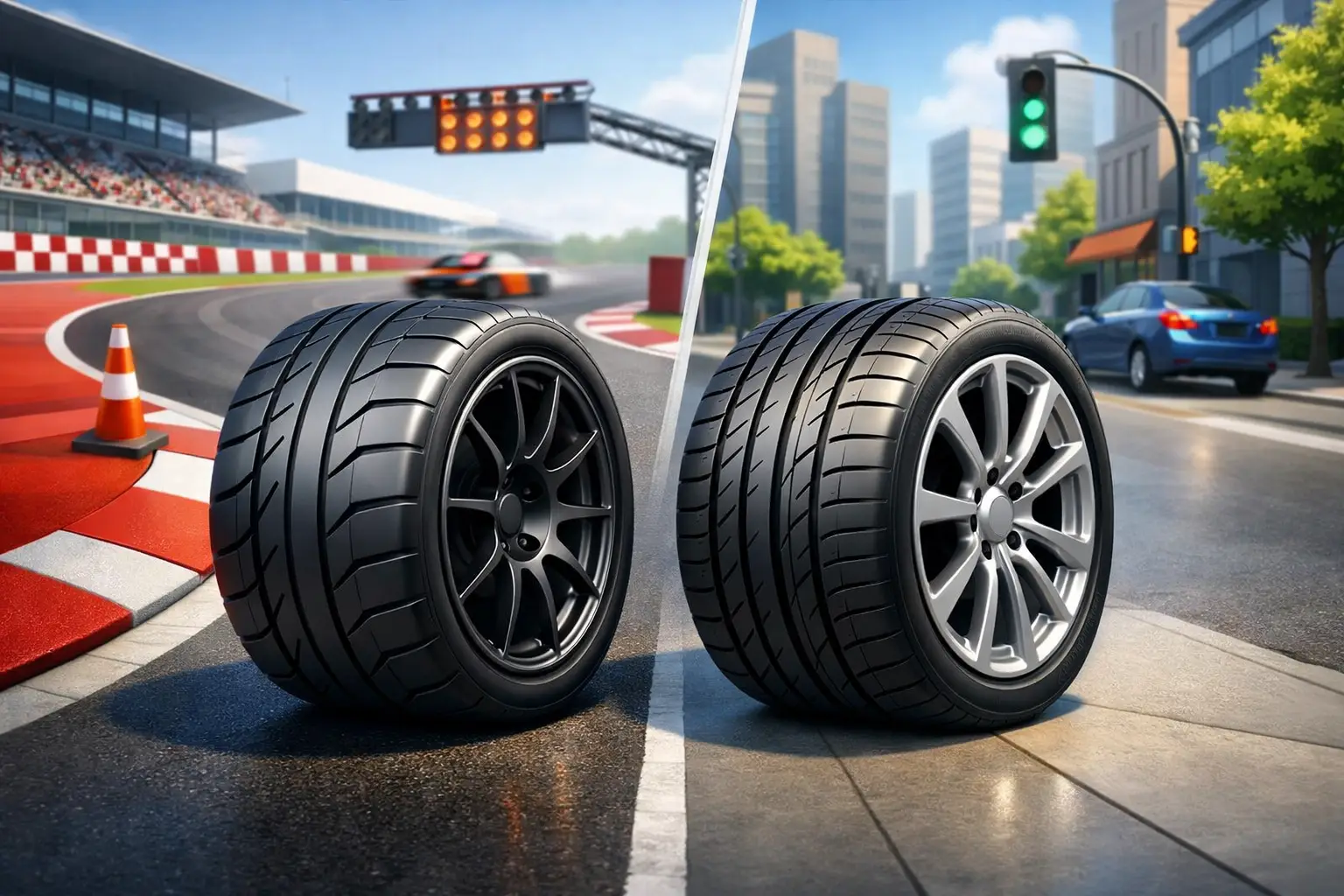
A fast lap can make track tyres feel like the obvious upgrade. But track tyres vs street tyres is not simply a question of which one has more grip. The right choice depends on where you drive most, how your car is used, local temperatures, wet-weather exposure, and how often you are prepared to replace a set.
For most drivers, a quality street tyre delivers the safer, better-value answer. For dedicated track days, a track-focused tyre can transform steering response, braking confidence, and cornering control. The key is matching the tyre to the job, then having it fitted and aligned professionally.
Track Tyres vs Street Tyres: The Core Difference
Street tyres are engineered for the real world. That means daily commuting, highway speeds, potholes, changing road surfaces, hot pavement, occasional rain, passenger comfort, and a useful service life. Their tread design and rubber compound must work across a broad range of conditions, including the moments when the road is less predictable.
Track tyres have a narrower mission. They are designed to build grip as they warm up, resist deformation under hard cornering, and provide sharp, direct feedback at high speeds. Many use a softer compound and a more aggressive tread pattern, while some are semi-slick or nearly slick. On a dry circuit, that focus can deliver remarkable traction. On public roads, it can bring compromises that are easy to overlook.
The label alone does not tell the whole story. There are performance street tyres that handle occasional track use well, and track-day tyres that remain road legal. Always review the specific tyre’s intended use, treadwear rating, load index, speed rating, and wet-weather capability before buying.
Grip: Why More Is Not Always Better
Track tyres typically produce greater dry grip once they reach their working temperature. Their rubber compound is formulated to become more adhesive under heavy braking and repeated cornering. A stiffer sidewall also reduces flex, helping the car react more quickly when you turn the wheel.
That extra grip is valuable when you are driving consistently on a closed course. It can shorten dry braking distances, improve stability through fast corners, and give an experienced driver clearer feedback as the car approaches its limits.
Street tyres need to create grip from the first few miles, not only after several hard laps. They use grooves and channels to evacuate water and maintain dependable contact with the road. A premium street tyre may not feel as sharp as a track tyre at the limit, but it will generally be calmer, quieter, and more predictable during daily driving.
There is also a point where more grip exposes other weaknesses. Brakes, suspension geometry, wheel alignment, and driver skill all affect how well a performance tyre works. Installing a track-oriented set on a car with worn dampers or incorrect alignment will not create the control you expect.
Heat Changes Everything
Tyres generate heat whenever they flex and grip. A track session creates far more heat than a typical highway drive, especially in warm Gulf conditions. Track tyres are built to tolerate that demand, but they still need correct pressure management. Too much pressure can reduce the contact patch and accelerate center wear. Too little can overwork the sidewall, make handling vague, and cause excessive shoulder wear.
Street tyres are not designed for lap-after-lap abuse. A hard track day can overheat them, making the rubber feel greasy and reducing grip. Repeated overheating may also shorten their life, even if the tread still looks acceptable.
If you attend occasional track days, a high-performance street tyre may be the practical middle ground. It offers strong dry handling without making every commute feel harsh or risky in wet conditions. Drivers who run frequent events often benefit from a separate wheel and tyre set reserved for the track.
Wet Roads Favor Street Tyres
Water is one of the biggest dividing lines between track and street use. Street tyres have deeper grooves and carefully shaped channels that move water away from the contact patch. This helps reduce the risk of hydroplaning and supports safer braking in rain or standing water.
Many track-focused tyres have limited tread depth and fewer channels. That larger rubber contact area helps on dry asphalt, but it can struggle to clear water. Even a road-legal semi-slick can lose confidence quickly in heavy rain, particularly as the tread wears down.
For a daily-driven car, wet performance should never be an afterthought. Rain may be less frequent in some Gulf locations, but when roads become wet after long dry periods, accumulated dust and oil can make conditions especially slippery. Choose a tyre that gives you control when the surface changes without warning.
Comfort, Noise, and Everyday Wear
The more focused a tyre becomes, the more you tend to notice it on the road. Track tyres commonly create more road noise, transmit more vibration, and follow grooves in the pavement more readily. Their firmer construction can sharpen the driving experience, but it can also make a family SUV or daily performance sedan less comfortable.
Wear is another major consideration. Softer compounds usually trade longevity for traction. A track tyre can wear much faster than a street tyre, particularly when driven on hot roads, used for frequent short trips, or run with incorrect alignment. The purchase price is only part of the cost. Replacement frequency, fitment, balancing, and potential fuel-efficiency differences all matter.
Street tyres are built for a more balanced ownership experience. Depending on the category, they can provide long tread life, lower noise, better ride quality, and stronger all-season or wet-road usability. That makes them the sensible choice for commuters, family vehicles, and drivers who want performance without constant compromise.
Choosing the Right Tyre for Your Car
Start with how your vehicle spends most of its time. If it handles school runs, office traffic, weekend highway travel, and occasional spirited driving, choose a reliable street or ultra-high-performance street tyre. You will get dependable grip, better rain performance, and longer usable life.
If your car is built around track days, autocross, or closed-course driving, track tyres may be worth the investment. They make the most sense when you can monitor pressures, inspect wear regularly, and accept that they are not the best solution for every road trip or weather condition.
Match the replacement tyre to the manufacturer-approved size unless you understand the effects of changing width, sidewall height, and overall diameter. The correct load and speed ratings are equally important, especially for heavy SUVs, high-powered cars, and vehicles that carry passengers or cargo. A tyre that looks aggressive but does not meet your vehicle’s requirements is not an upgrade.
It also pays to replace tyres as a complete axle pair at minimum, using the same model and size on that axle. On many all-wheel-drive vehicles, differences in rolling circumference can affect the drivetrain. Check your owner’s manual and ask a qualified fitter if you are unsure.
Do You Need Two Sets of Wheels?
For serious enthusiasts, two sets can be the smartest answer. Street tyres remain on the car for daily use, while track tyres are mounted on a separate set of wheels for event days. This protects the track set from unnecessary road mileage and lets you select a tyre that suits the circuit without sacrificing wet-road confidence.
It does require storage, upfront cost, and discipline. You need to inspect both sets, keep track tyres protected from prolonged heat and sunlight, and confirm that wheel fitment clears the brakes and suspension. Still, for drivers who attend several events each year, the flexibility can be worth it.
Fitment and Alignment Matter as Much as the Tyre
A new set of tyres cannot perform properly if the wheels are out of balance or the alignment is wrong. Incorrect toe or camber can wear the inner or outer shoulders rapidly, reduce straight-line stability, and make a capable tyre feel disappointing.
Professional fitment gives you the right foundation. At GCC Tires, customers can choose from trusted brands, match tyres to their vehicle and driving needs, and arrange professional fitment with alignment and balancing support. Before leaving the shop, confirm the recommended cold pressures and ask how often to inspect them, especially if you drive hard or carry heavy loads.
The best tyre is the one that gives you confidence in the conditions you actually face. Choose track tyres for the circuit when maximum dry performance is the goal, choose street tyres for the road when safety and everyday value lead the decision, and never let appearance outrun proper fitment.